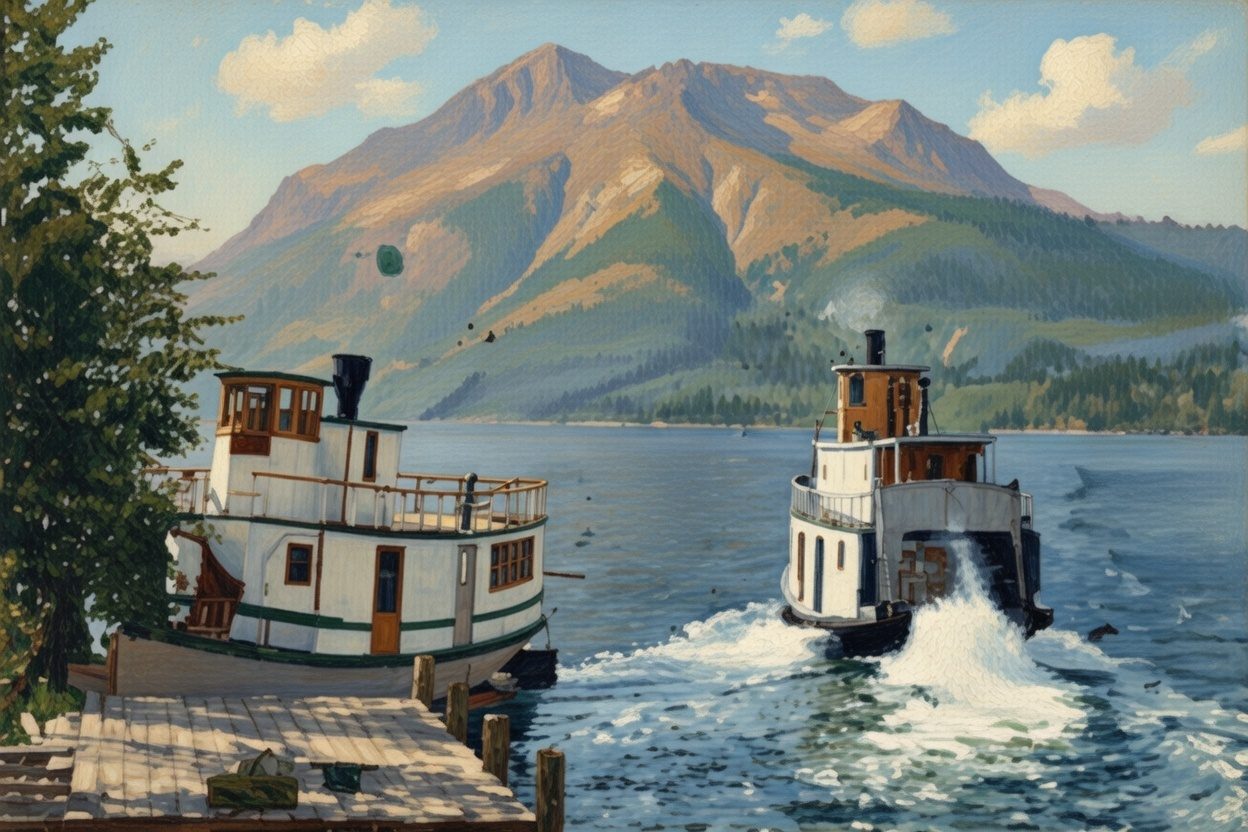
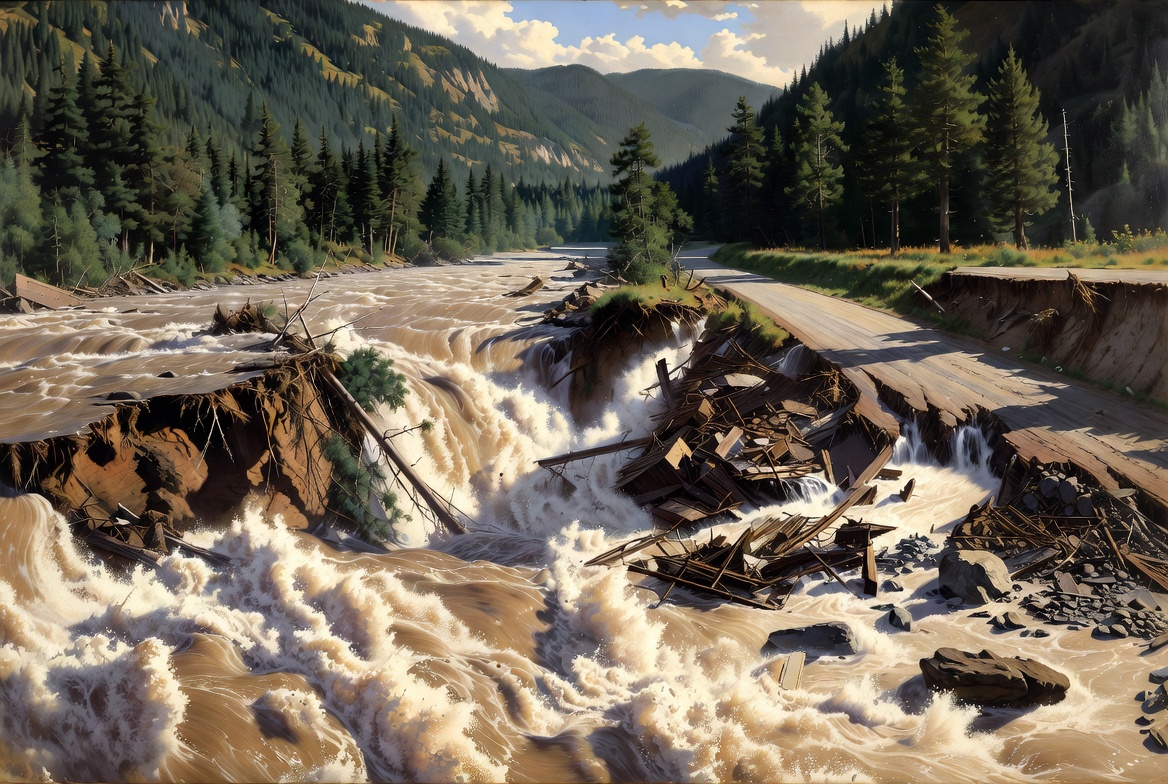
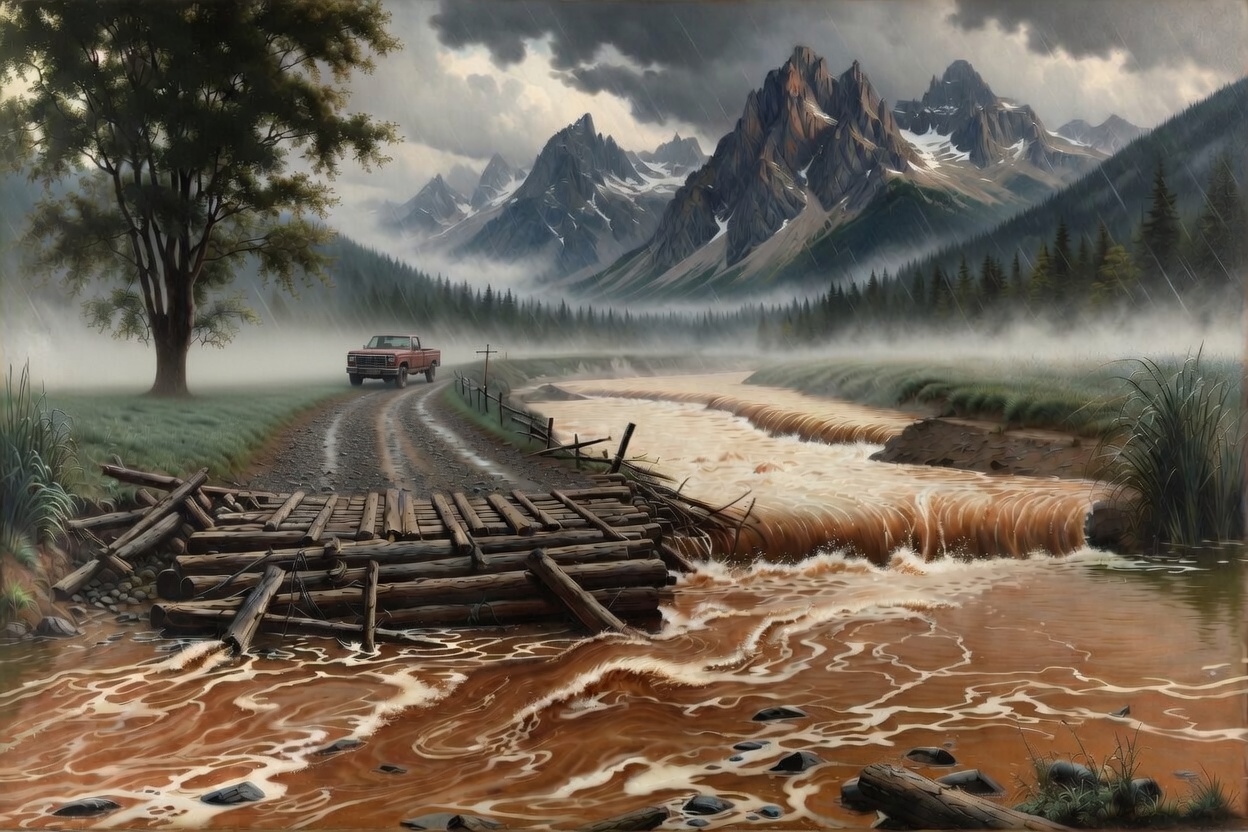
In the early morning of December 11, 2025, the Stehekin River surged to the second highest peak flow ever recorded. A staggering 21,000 cubic feet per second tore through the valley. This powerful natural event destroyed much of the protective levee along Company Creek Road and washed out several hundred feet of critical roadway. The river then carved a dramatic new channel southwestward along Battalion Creek, slicing across the entire Stehekin Valley floor all the way to the western hillside. Bouncing off the rock bluffs, it turned northeast again before recrossing Company Creek Road at Lesh’s Corner. That point sits approximately 1.2 road miles from the original breach. Local resident Wendy Garfoot’s home was inundated with over 21 inches of water. Multiple full time Stehekin families were temporarily surrounded by swift waters and completely cut off from access.
Just four days later on December 15, the Stehekin River experienced another significant event. Although this surge did not reach the same peak levels as the earlier flood, it caused even more damage. The ground was already saturated from the previous event, and the water receded much more slowly. The remaining structure of the Company Creek Road levee was completely destroyed, and the river began to back-cut aggressively onto private property just west of the original levee location.
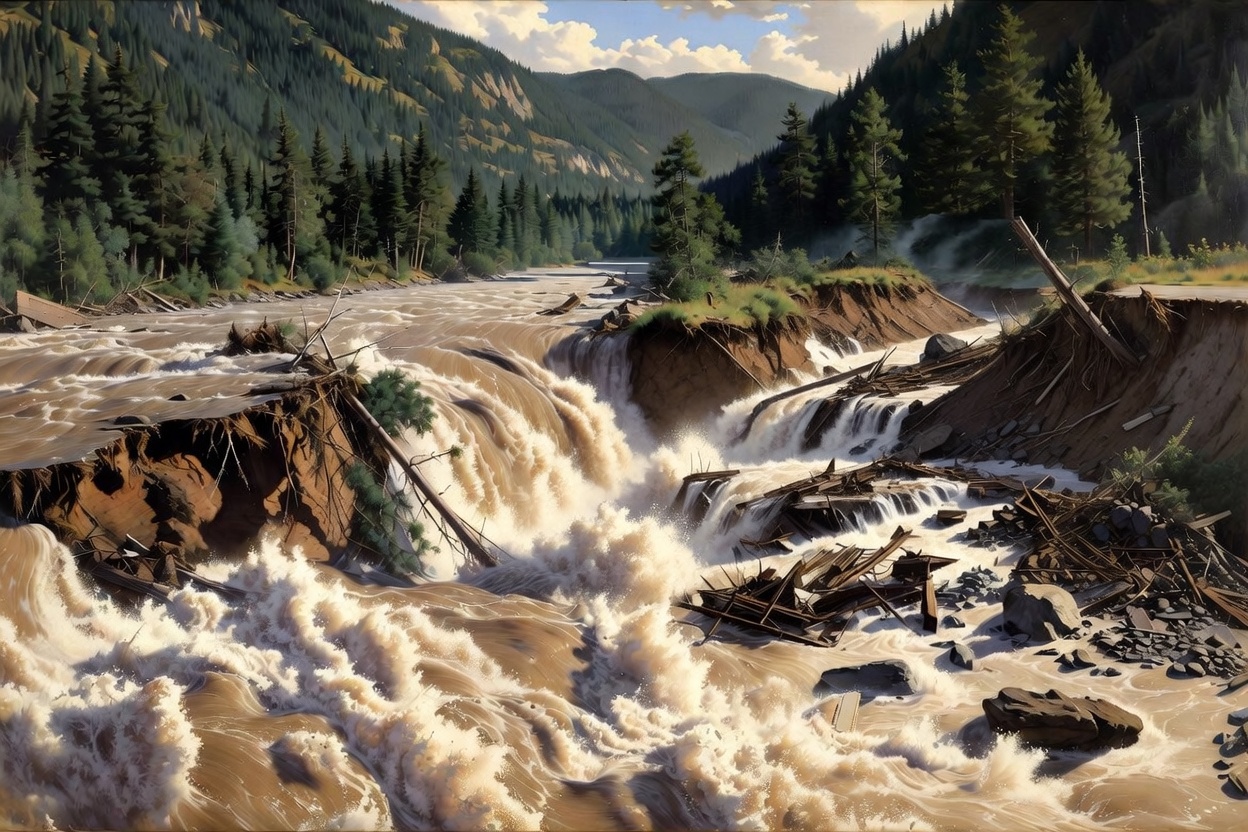

On December 19th, day eight, Stehekin residents stepped up with remarkable community spirit. Using donated funds, they organized helicopter loads to be dropped to their stranded neighbors. These deliveries included groceries, animal feed, fuel, and even Christmas presents, bringing hope and practical support to families still cut off by swift waters.
On December 22nd, day 11, residents stranded above the levee washout began constructing a corduroy road with impressive ingenuity and self-reliance. They cut logs that had washed in and formed a log jam along the riverbank to lengths manageable by an excavator. The logs were then stacked perpendicular to the direction of travel, spaced closely enough for a tracked vehicle to cross safely. A wheeled loader hauled cobble from private property to surface the corduroy road. The route was built as close to the riverbank as safely possible.


The power has been out for almost two weeks. Finally on December 23rd, day 12, power was restored to all but one of the residences above the levee washout.
On December 24th, day 13, the excavator finished placing logs in the corduroy road all the way to the end of the first washout. Although it was not an easy crossing, foot travel was now possible. On the lower end of the washout, where the new river channel crosses the road at Lesh’s Corner, the water level dropped enough for local crews to spread sufficient spalls in the roadbed, making a vehicle crossing possible. Vehicle access was now restored to within half a mile of the upstream residences.
On December 25th, day 14, Christmas was joyfully celebrated above the levee washout as family and friends hiked in for the first time since the flood.
Despite the damage and uncertainty caused by the floods, the people of Stehekin chose joy over despair. Families gathered to celebrate Christmas together, sharing meals, laughter, and gifts, many of which had been delivered by helicopter just days earlier. Their ability to stay optimistic in the face of all that has happened, while expecting the best in others, reveals the true heart of Stehekin: a community of great, kind, and resilient people who refuse to let hardship define them.

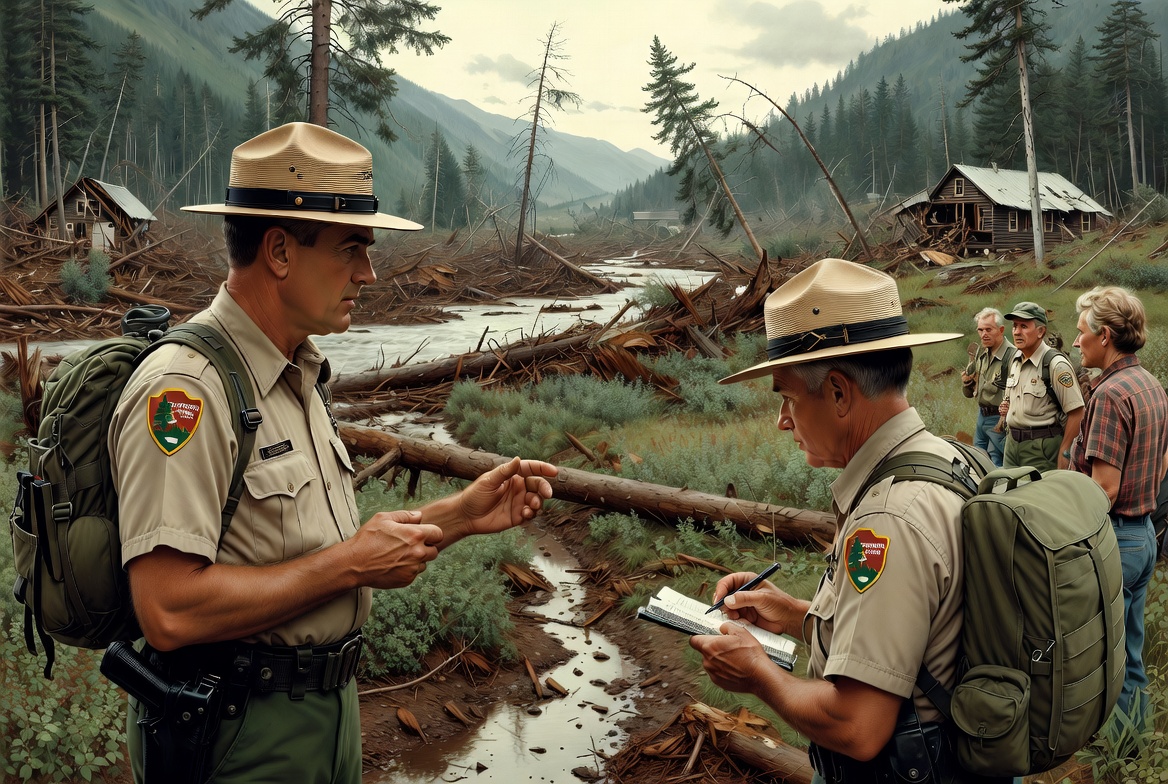
On January 5th, day 25, after 25 long days during which the community was left ignored by the National Park Service, officials finally visited Stehekin for the first time since the floods began. For nearly a month, residents had suffered being stranded and cut off from normal access and support. Constrained by National Park Service policies and fearful of potential repercussions if they acted independently, they were significantly limited in their ability to begin rebuilding and recovery efforts. The officials finally begin to surveyed the damage and met with local residents.
January 6th, day 26, power is restored to the last residence above the washout.
On January 13th, day 33, the Stehekin River experienced another small flood event, peaking at approximately 3,500 cubic feet per second (CFS) around noon. Prior to the levee being washed out, this modest volume of water would have barely been noticeable. Without the protective levee in place, however, the river followed the new channel it had begun carving into Battalion Creek. The surge washed out part of the community-built corduroy road, temporarily stranding residents once again, and flowed across the road at Lesh’s Corner, washing away the recently patched surface over the culverts.
On January 15th, day 35, the North Cascades National Park Complex (NOCA) Superintendent and other National Park Service officials visited Stehekin for the first time since the December 11th flood. They toured the flood-damaged areas and met with some local residents.
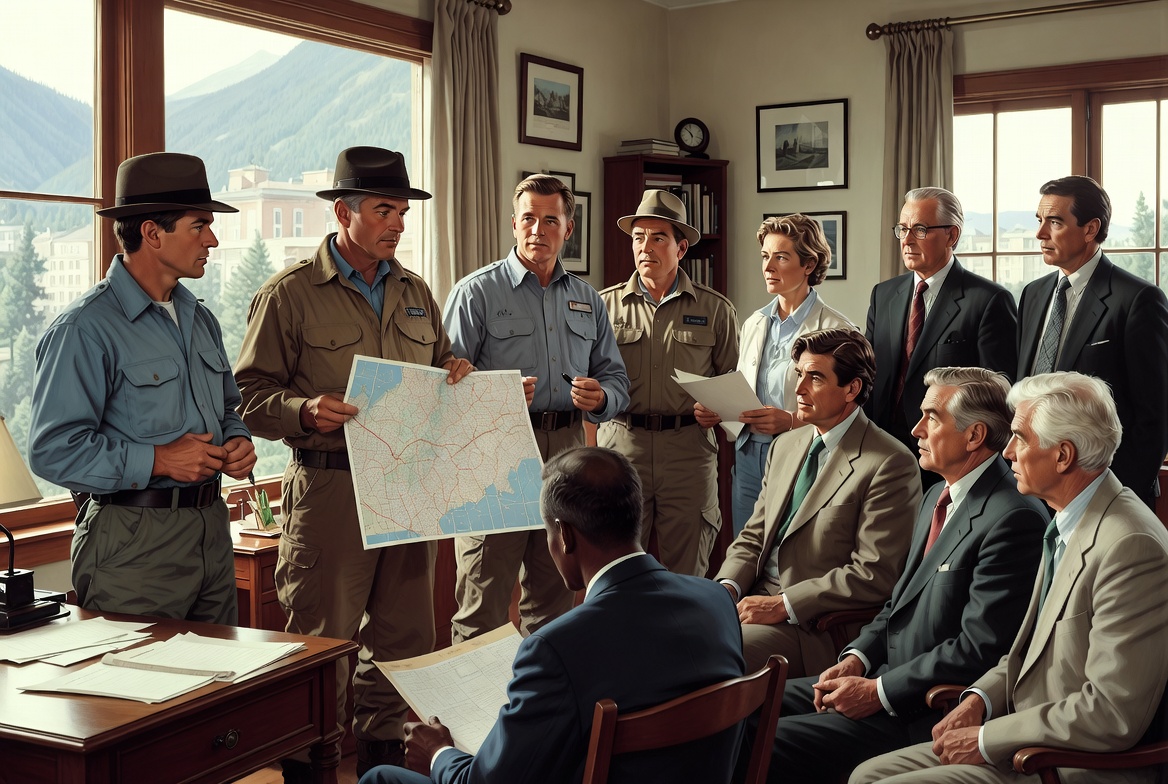
On January 22nd, day 42, residents of the Stehekin Valley traveled to Wenatchee to present a comprehensive plan for repairing the washed-out section of Company Creek Road to elected officials and National Park Service representatives.
This practical and detailed plan was developed by lifelong Stehekin residents, people who have lived in the valley their entire lives and possess unmatched knowledge of the river, having worked in and around it for decades. The proposal calls for armoring the north bank of the Stehekin River to protect private properties, restoring the river to its original channel, and rebuilding the road in its proper historic alignment. Cost estimates for the project range between $250,000 and $400,000.
The plan was well received, but received no firm commitment from any agency. Notably, this was the first time anyone had publicly presented a concrete plan to restore road access to the upper Company Creek Road. The proposal strongly recommends that all construction be completed by March 15th, before spring runoff begins.
On January 23rd, day 43, once again the community had only itself to rely on. Residents above the washout pulled the logs that had washed out of the corduroy road on January 13th back into place and finished topping the road with cobble sourced from private property. Once completed, vehicle access, though still difficult, became possible. Residents were finally able to move vehicles that had been stranded since December 11th down to the road below the washout. While not suitable for regular commuting, the improved route made access significantly easier.


On January 28th, day 48, the National Park Service sent an email stating their belief that there were “no simple or immediate solutions” to the situation. This response highlighted what appeared to be a complete lack of urgency from the NPS, even as residents remained stranded for weeks and local students faced an extremely difficult and hazardous time getting to and from school.
On February 10th, day 61, representatives from the National Park Service, the U.S. Army Corps of Engineers, Chelan County, and the Washington Department of Fish and Wildlife traveled to Stehekin to assess the situation. Local residents who had written the practical road repair plan presented to elected officials in Wenatchee on January 22nd were explicitly told they were not allowed to participate in the walk-through and assessment. Instead, a hydrologist hired by an outside environmental activist group that has historically opposed any work in the Stehekin River was invited to accompany the agency representatives on the tour.
Later that same day, a public meeting was held in Stehekin. It was advertised as featuring representatives from Chelan County, the National Park Service, the Army Corps of Engineers, and the Washington Department of Fish and Wildlife. Notably, no National Park Service representatives attended the meeting, even though at least one was present in the valley at the time.


On February 7–14, day 65, the National Park Service installed a trail camera directly across the river from the private properties most affected by the flooding. The camera was pointed straight at those homes and properties. It was placed by a federal law enforcement officer and appeared intended to document any “illicit” work locals might attempt in the river, presumably for future prosecution.
Up to this point, it was the only visible action the National Park Service had taken since the floods began.
The National Park Service’s actions, or more accurately, its persistent inaction, demonstrate a profound lack of good faith and a clear unwillingness to trust the Stehekin community as a true partner in solving this problem. Instead of working alongside the very people who know the river, the land, and the valley better than anyone else, the NPS has chosen surveillance cameras pointed at private homes, exclusion of local experts from official assessments, and repeated bureaucratic delays.
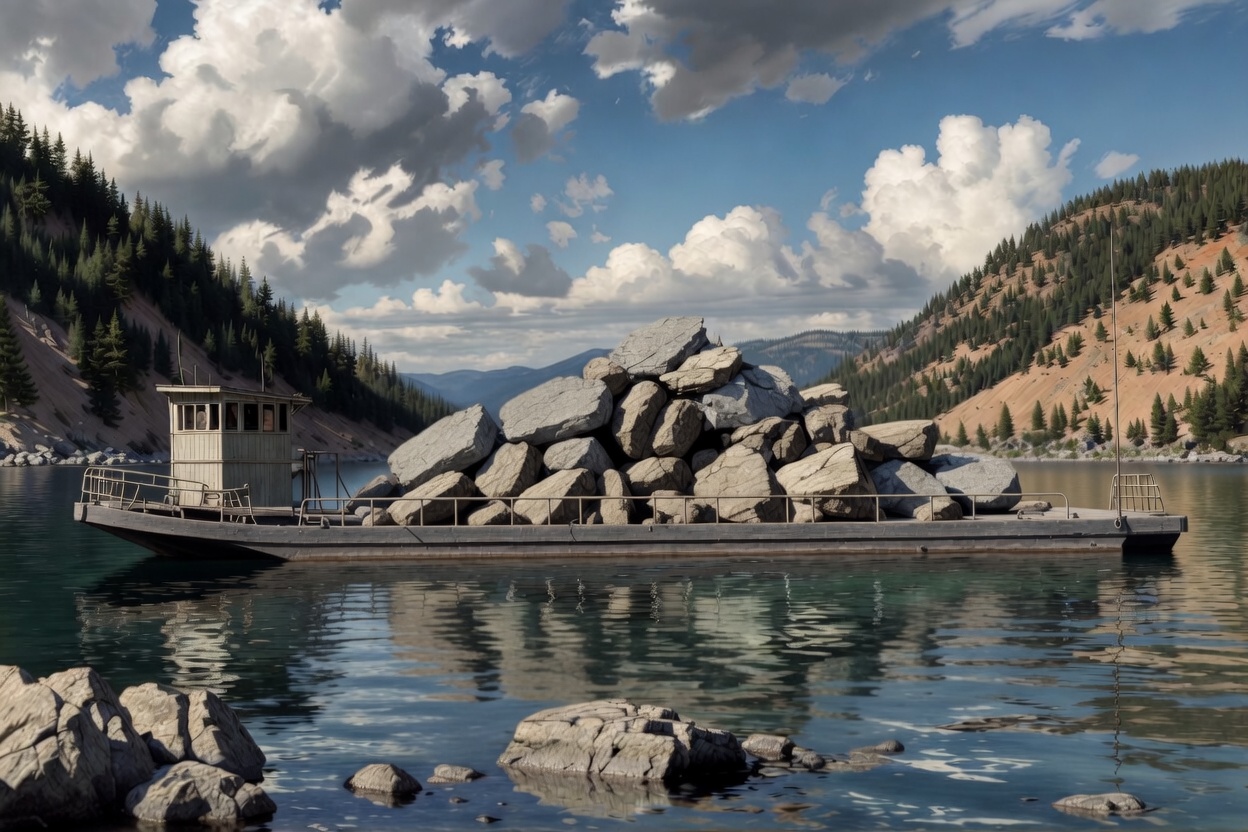
On February 18th, day 69, Chelan County began purchasing 5,000 tons of rock in good faith, believing the National Park Service was actively working to design a permanent road repair that would benefit county residents. Due to NPS policy, however, no locally sourced large rock could be used. This meant the material had to be barged up Lake Chelan in 250-ton loads.
Recognizing that time was becoming critical, Chelan County acted proactively rather than wait for the NPS to finalize its plans, a delay that could have meant months of additional waiting for material delivery. The first barge load arrived today. The National Park Service refused to allow the rock to be stockpiled on federal land, so private residents immediately stepped forward and agreed to store it on multiple pieces of private property.
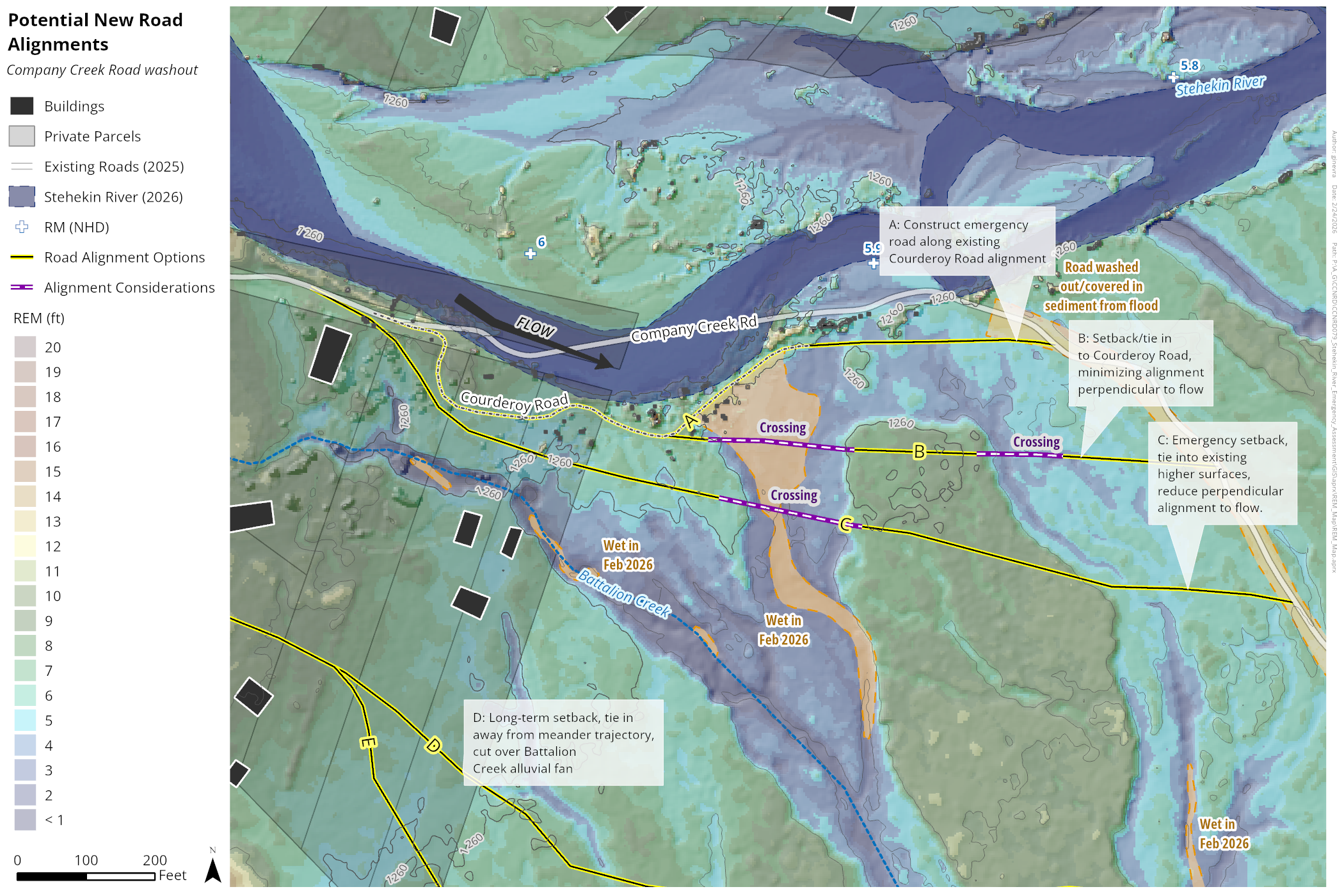
On March 5th, day 84, the National Park Service released its first public plan for the location of a new road. The plan showed multiple possible routes, all of which crossed or terminated on private property at the west end of the washout. Several routes were extremely long, proposing to travel more than a mile through virtually untouched portions of the Stehekin Valley. These alignments would cross Battalion Creek multiple times, pass through numerous beaver ponds, and cut directly through a stand of old-growth Douglas fir. Two of the five proposed routes would slice across six separate pieces of private property, running between two domestic wells and directly through large family gardens.
Notably, none of the routes included any protection for the clearly fragile eastern section of the existing road. If the river is not controlled at the east end of the washout, there is a high likelihood that another half mile of road could be lost, along with multiple pieces of private property.
On March 20th, day 99, the Stehekin River experienced a “10-year” flood event, reaching peak flows of just under 12,000 cubic feet per second at 4:30 p.m. The surge was driven by a combination of heavy rain and warm weather rapidly melting low-elevation snow. Although this was one of the highest March flows ever recorded on the Stehekin River, it was not an uncommon level for the river to reach. Notably, the event struck just five days after the March 15 deadline recommended in the community’s road repair plan.
This flood completely washed out the corduroy road and further widened the new channel the river had carved down Battalion Creek. Residents were stranded once again, and the road at Lesh’s Corner became impassable. Properties that, prior to the original levee breach, would never have been surrounded by water at this flow level were now completely encircled. As the waters receded, it became clear there was no realistic hope of restoring the corduroy road using the equipment and material available on the upstream side of the washout.
Every additional day of isolation, every washed-out corduroy road, every flooded home, and every preventable hardship the people of Stehekin have endured since December 11th could have been entirely avoided if the National Park Service had simply done its job and restored the Company Creek Road in a timely manner.

On March 25th, day 104, the National Park Service announced that a contract had been awarded to ECC to build the new road.
On April 1st, day 111, contractors began clearing trees along the proposed road reroute. The route requires the removal of more than 110 trees, ranging from 6-inch-diameter dogwoods to 5-foot-diameter old-growth Douglas fir. It runs a significant distance from the riverbank and terminates directly on private property, meaning that, under current plans, only the owner of that single parcel would legally have access to the new road.
The plan also fails to address the vulnerable east end of the existing road. It simply terminates the new alignment in the woods, with no protective structure to prevent the river from continuing to erode until it reaches the raised roadbed. This would dump massive amounts of cobble and trees into an already overloaded river channel. There is likewise no structure shown to stop the river from following the road down the valley, which could destroy many more feet of roadway and threaten at least six additional pieces of private property.
The proposed route has been met with understandable local disbelief and strong resistance.
On April 2nd, day 112, local moms organized a peaceful protest. Members of “Moms with Muffins” and “Ladies of the Lake” sat directly in the path of the proposed road reroute, peacefully passing out muffins and refusing to move out of the way of the equipment and falling trees. Work was brought to a complete stop.
On April 3rd, day 113, the protests continued.
On April 5th, day 115, National Park Service officials arrived to walk the route and speak with locals. “Moms with Muffins” reluctantly called off the protest after receiving assurances from the NPS that, at a minimum, the vulnerable east end of the road would be protected in a revised “Version 1.5” of the plan. The group hoped this would allow work to begin immediately on the lower, undisputed section of the original road while a final decision was made on the upper, highly contentious reroute.


On April 9th, day 119, work remained at a complete standstill until the situation could be resolved. Residents above the washout were entirely cut off. Young children were forced to walk 40 minutes through the woods each day just to get around the washout and reach school. Vehicle access was completely impossible. When National Park Service officials were asked about emergency access, they responded that they had been ordered to stop all work. The NPS had 400 bulk sandbags already filled and ready, sitting in their rock pit less than two miles from the washout, yet they remained unused. For any resident who was not physically fit, the only possible way to leave the area above the washout was by helicopter.
On Saturday, April 11th, day 121, exactly four months, 121 days, will have passed since the original flood destroyed the Company Creek Road levee.
To this point, the only visible actions taken by the National Park Service have been to install a trail camera pointed directly at private homes and to propose an extremely expensive road reroute that cuts through old-growth timber before terminating on private property. The estimated cost of this plan approaches three million dollars, yet it would solve virtually none of the problems Stehekin residents have faced for the past four months.
The winter of 2025-26 was one of the mildest Stehekin has ever recorded, providing an ideal window for construction that could have been ongoing all winter long. For comparison, on the very same day the levee failed, a massive landslide blocked the main Stehekin Valley Road just above the boat landing. Local contractors working for the NPS cleared nearly 7,000 cubic yards of material and reopened the road in just a couple of weeks. Large-scale projects and effective cooperation between the NPS and locals are clearly possible when there is the will to act. The hold-up lies not with the dedicated NPS employees who live and work in Stehekin, but with higher-level officials who have shown a persistent and unacceptable lack of urgency.
NPS leadership has stated they will not work in the river. Yet their refusal to return the river to its original channel means any future road will have to cross roughly one-third of the river’s volume where it now spills into Battalion Creek. Work has been successfully completed in the Stehekin River in the past. Importantly, Stehekin is not a national park, and the Stehekin River is not designated as “wild and scenic.” Such work is both legally permissible and historically precedented.
As it stands today, the situation has no end in sight. The National Park Service’s repeated delays and inaction demonstrate a profound lack of good faith and a clear unwillingness to treat the Stehekin community as a true partner in solving this problem. Providing temporary emergency access while a long-term solution is finalized should be the bare minimum. Temporary access should not cost three million dollars. The corduroy road built by locals using only a chainsaw, an old excavator, and an old loader cost virtually nothing. Though rough, it delivered effective emergency access and was constructed in just a few days with very limited resources. It lasted five days longer than the mid-March deadline locals repeatedly urged all officials to meet.
The route locals used for the corduroy road was approximately 700 to 900 feet long. If three or four residents with minimal equipment and materials could provide emergency access over that distance in a matter of days, it speaks volumes about what the National Park Service has failed to accomplish in four full months.
Until meaningful action is taken, residents remain forced to wait. Above the washout, three families are completely cut off. Their children make up one-third of the total Stehekin school enrollment. Every school day, these children, the youngest of whom is only eight years old, must hike 40 minutes through brush and bluffs just to reach a vehicle. The return trip brings the daily total to nearly an hour and a half of hiking. Residents with livestock are within two weeks of running out of animal feed. Propane supplies for cooking and heating water are becoming critically low. In the event of a medical emergency, if weather prevents helicopter flight, there is no safe way to transport a patient.
A disabled Vietnam veteran and his wife own a home above the washout on land homesteaded by his grandparents. They were able to access their property using the corduroy road. Now even that option is gone, and he can no longer reach his own home. Below the washout, several properties are surrounded by swift, knee-deep water. One belongs to a retired couple who can no longer leave their home without wading through substantial water. Their income depends on renting a small cabin on their property, which they will be unable to do until the situation is resolved. Two other families with school-age children have had to miss school multiple times or risk crossing cold, swift water to reach their vehicles.
All of the impacted properties were purchased and improved with the clear expectation that the National Park Service would maintain the road and protective levee. After four long months, the NPS has clearly failed to meet that responsibility. Every additional day of isolation, every hardship, and every preventable crisis could have been entirely avoided if the National Park Service had simply done its job and restored the Company Creek Road in a timely manner, exactly as Congress intended when it created the Lake Chelan National Recreation Area to protect a living, working community, not to paralyze one.